Brussels summer school NEED TO KNOW

Engage London includes more than 20 people on the #hearmespeak team. A lucky eight are going to Brussels for a summer school. Below are the final workshop choices and our code of conduct.

Brussels summer school preparation: Standing: Savas Panas, CEO Pilion Trust, Nicola Baird, journalist. Sitting: Rahim Amin, Favour Ekengwu, Naomi Gahie. (c) Engage London

We all picked workshops in advance and are looking forward to learning all sorts. Here are the workshop choices (three not four):

1 Brussels CODE OF CONDUCT created by Rahim, Favour and Naomi (but for everyone!)

  • Treat everyone with respect.
  • Professional behaviourthis is a workshop so think of it as work. It’s not a holiday. Be respectful in the workshops & be sure to get up in enough time to arrive at the workshops on time. If you are late for the start it interrupts everyone else. Don’t be that late person.
  • Professional behaviour for 24 hours a day, not just in the workshops. So in the hostel keep quiet at night so people can sleep.
  • You are ambassadors for Engage London.
  • #HearMeSpeak also means #ListenToOtherPeople
  • Any problems just speak to someone, especially Nicola and Savvas. The co-ordinators at IHECS are Laura and Esther.


2 TIPS to keep you safe and on time

  • Take the hostel address card when we check in. It’s easy to forget the address and location of a hotel!
  • Take a map of where the hostel is and keep it on you. If you get lost use this map to get ‘home’. Ideally stay with others from Engage Europe. But if you need to pop out on your own, tell someone.
  • You’re in a different country so there are different customs for food, language, swearing, smoking and drink. Pay attention to these differences.
  • Use caution with alcohol (Belgian beer is strong!)
  • Make friends with the Engage Europe teams from Germany, Romania, Belgium and Spain. Hopefully you’ll see them again in London (Oct) – or even Barcelona (Nov) or Brussels (Dec).

3 BRUSSELS WORKSHOPS CHALLENGE for Engage London

>Every day take a photo that tells a story and share on our WhatsApp.

We’ll use the best for a photo show back in London with the others. Please do not clog up the Engage London WhatsApp with selfies – we want photos that show what you are up to, not just your face!
 

Planning at Thomas More University, Mechelen, Belgium

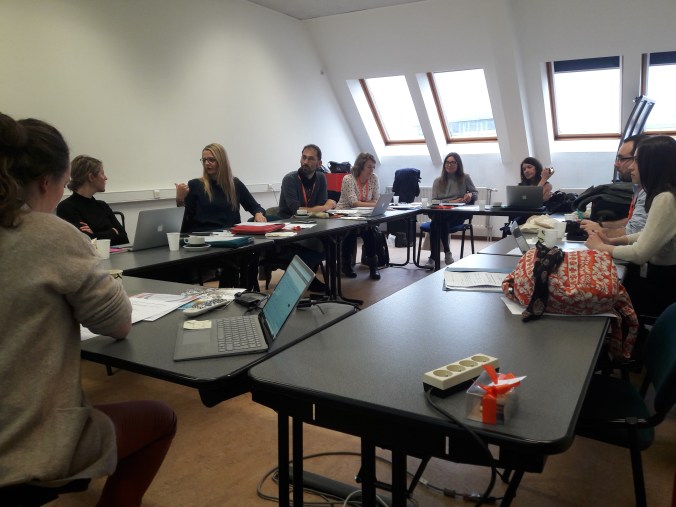
15 March 2018: Engage Europe colleagues, co-ordinated by Laura and Esther from IHECS (Brussels), met at Thomas More University, Mechelen, Belgium. Report from City, University of London team.

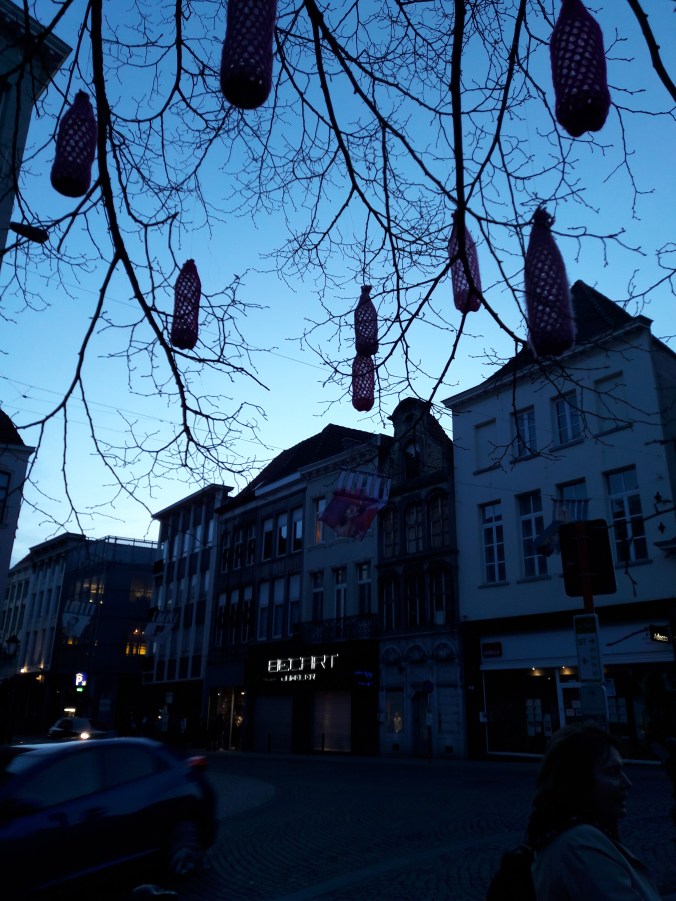
Yarn bombing by old houses along the River Dyle in Mechelen, Belgium (c) Engage London

Q: Where is Mechelen?
Mechelen is in Belgium – quite close! London to Brussels via Eurostar takes just two hours. From Brux Midi station (Brux Midi is the station’s French name; in Flemish it’s Brux Zuid and in English Brussels South) it’s about 20 minutes on another train to Mechelen.

Q: Tell me the basics
Mechelen is midway between Brussels and Antwerp. It’s both a tourist magnet and a university town (a little like York in the UK). The centre boasts the huge 13th century St Rumbold’s cathedral. Facing it is a large city-centre square lined with cafes. At busy commuting times there seems to be an urban ballet performed in the square as bikes weave around pedestrians.

About two years ago Mechelen was traffic-calmed, prioritising people and bikes, over vehicles. As a result us Londoners found it really quiet in the centre. You can actually hear the big Belgian bikes bouncing over the cobbles. Cars can come into the centre in the evening to park in the underground car park beneath the city square. There are buses, but they aren’t red.

Walking and cycling are nice ways to travel around Mechelen to reach Thomas More University. (c) Engage London

=====
Have you heard of this Belgian city?

  • MECHELEN is where Anne Boleyn (1504-36), who famously lost her head to Henry VIII, spent a part of her childhood.
  • Charles V (1500-1558), known as the Holy Roman Emperor (basically he was King of Spain and Italy and parts of Germany until he abdicated to retire to a monastery in 1556) was brought up in Mechelen until he was 17.
  • Mechelen did have a protective city wall and 12 gates. There’s one still standing, known as The Brusselpoort.
  • In the central square the city palace is still used. It is known as the Hof van Busleyden. Years ago philosophers Erasmus and Thomas More both visited this palace, possibly sharing their ideas.
  • Upsettingly Mechelen’s good train links are why between August 1942 – July 1944 the invading German Nazis chose it as a collecting point for the 25,000 Jews and Roma they sent by train to Auschwitz-Birkeneau. At the end of the war when the concentration camp was liberated only 1,240 were still alive (reference).

======

Engage teams from six universities: Laura (IHECS, Belgium), Anne (Belgium), Esther (IHECS, Belgium), Kiron (Germany), Barbara (London), Caroline (London), Charo (Spain), Cristina (Spain, not in pic), Ovidiu (Romania), Alexandra (Romania) and Nicola (not in pic). (c) Engage London

Engage Europe at Mechelen 
Thomas More University, one of Engage Europe project’s academic partner institutions, is on the ring road. At this centre a team from universities in the European towns of Brussels (IHECS, Laura & Esther), Barcelona (Charo & Cristina), Tübingen (Kiron), Cluj (Alexandra and Ovidiu) and our host Mechelen (Anne) provided updates on their Engage work.

Representatives from City, which is based in Islington, London, shared a powerpoint, film and the gallery on our blog to introduce the young people from the Pilion Trust. Our Hear Me Speak film got a round of applause, so thank you again everyone involved in creating it, in front or behind the camera.

To date radio, podcasts and photography have been the most popular ways around Europe to share media skills and give the young people’s perspectives a voice. Find out more by looking at the partner blogs, see here.

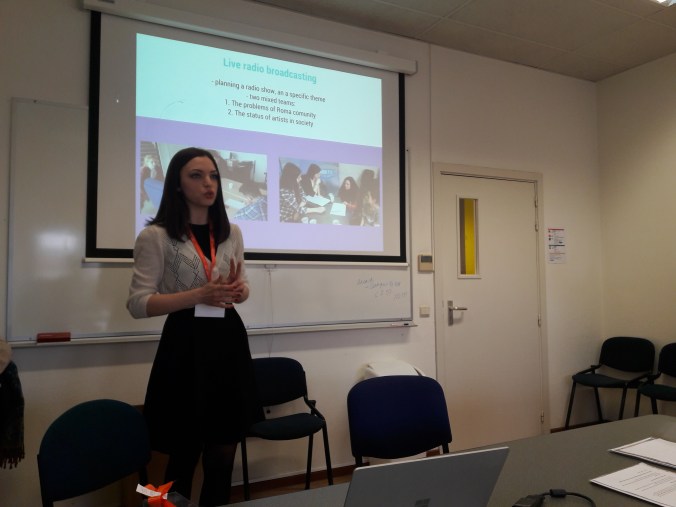
Alexandra from Babes-Bolyai University in Cluj-Napoca shares Engage Romania’s radio work with Roma, young people with disabilities and also Down’s Syndrome. (c) Engage London

Next meetings during 2018 will all involve practical media collaborations (eg, radio, photography and more). Planned activities include a summer school from 25-27 June (Brussels) and workshops in Cluj-Napoca (24 May-1 June), London (date TBC) and Barcelona (date TBC). We’re so excited for London!

Graffiti on the train at Mechlen. In Brussels we saw brilliant designs everywhere. (c) Engage London

What’s fake news?

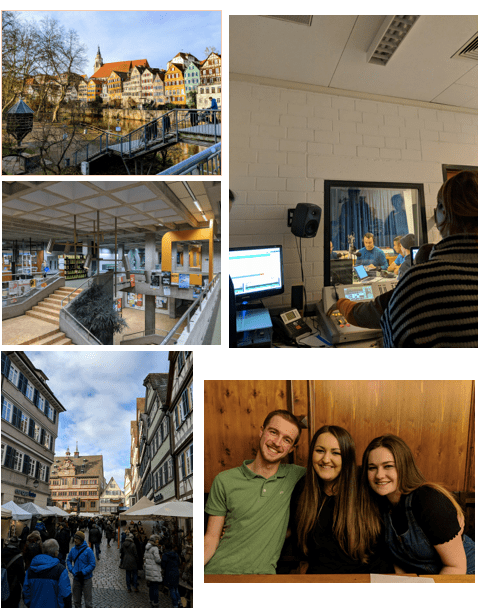
Tubingen, Germany 2017: overview of the two-day workshop from Engage London’s Amelia Green (words) and Alun Macer-Wright (photos) who are both studying journalism at City, University of London.

Round up of fake news workshops and exploring Tubingen University in Germany from Engage London participants (c) Alun for Engage London

The participants at the workshop in Tübingen were students from each university and their partners. The number of students and partners varied depending on the institution but overall there were roughly 25 of us.

The topic of the Tübingen workshop was Fake News and its impact on the media in the current climate. There was a focus on Donald Trump, the different types of fake news, how people make a profit and how to identify fake news.

Tübingen University invited online blogger, Martin Giesler to lead the workshop. The two-day assignment began with a 20-30-minute presentation from Giesler, in which he explained the relevance of fake news, included news clips and made it clear what we would be working on.

The aim of the workshop was to work in groups of 3 or 4 and produce a 1 minute audio clip that could be used in a radio show on fake news. This radio show would be recorded on the final day with a select panel of volunteers from nearly all universities, their partners and Martin Giesler.

The groups we worked in to produce the audio clips were based on what sub-topics we were interested in regarding fake news (Trump, making a profit etc.). We were responsible for recording, editing and getting the clip to Giesler to use in the show. We all then had the opportunity to view the live broadcast.

At the end of the workshop, each university and partner gave a brief presentation detailing what their chosen workshop topic was and what we could expect from them. Furthermore, we had a brief discussion of what had been accomplished so far and what was to come. This included feedback on the workshop and an overall feeling that having an online page to communicate was more productive than having a quick, unprepared discussion. This was how the Facebook group became active, although has not really been used yet.

The trip allowed us to get to know all the other students and partners. We got to explore Tübingen, see how beautiful it is and visit the Christmas market. The evening meals and drinks provided a further opportunity to socialise with the whole group and meet some great people.

Over to you
If you have any questions let us know.